102,000 Reports. 18 Years. What the National Hotline Data Shows About Trafficking Trends
Mar 23, 2026
The National Human Trafficking Hotline does not measure how much trafficking exists. It measures who reaches out.
That distinction shapes everything about how to interpret the data. But when you have 18 years of it, covering 102,555 trafficking situations across every state, the patterns become powerful.
This is the fourth post in our series on the 2026 State Human Trafficking Report. It focuses on hotline data from 2007 to 2024, presented by Megan Lundstrom, CEO of Polaris, which operates the National Human Trafficking Hotline.
What the Hotline Captures
The hotline receives contacts through calls, texts, web chats, emails, and online tips. Each contact is a signal. From those signals, the hotline codes situations, which represent distinct potential trafficking cases. Only situations with sufficient detail are included in the dataset.
This means the data captures suspected trafficking surfaced through public reporting channels. It does not include trafficking that goes unreported, unrecognized, or disclosed through other pathways.
Four important limitations apply. The data captures only what is reported to the hotline. Awareness, language access, trust, and outreach influence who contacts it. Some demographic and venue data are incomplete. And the data measures reports, not verified situations.
Despite these limitations, 18 years of data provide critical insight into how trafficking is being identified in real time across states.
The Big Numbers
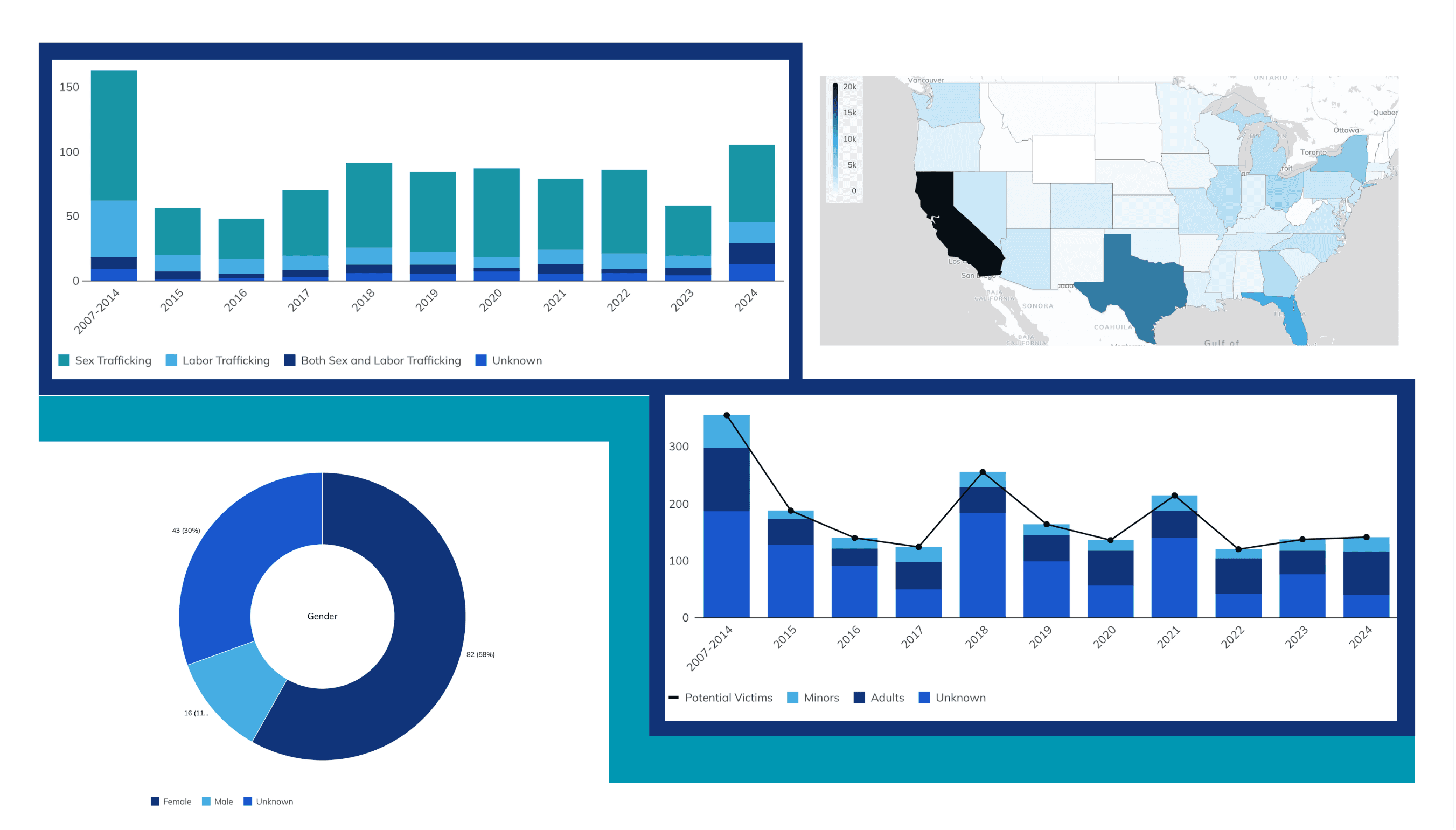
From 2007 to 2024, the hotline identified 102,555 trafficking situations and 219,832 potential victims.
The states with the highest total situations were the three most populated: California, Texas, and Florida. But when adjusted for population, the picture changes. Nevada, Delaware, and South Dakota rank highest per capita.
As Lundstrom explained, raw counts and per capita rates tell different stories. High-volume states reflect population size and reporting infrastructure. Per capita rates could signal concentrated vulnerability or strong reporting pathways.
Labor Trafficking Is Rising
Two major shifts emerged over the 18-year period.
First, reported situations declined during the COVID years beginning in 2020. This likely reflects reduced reporting rather than reduced trafficking. Public movement and institutional access points were limited, cutting off many of the channels through which trafficking is identified.
Second, the composition of trafficking types has shifted. In 2015, labor trafficking represented 15% of reported situations. By 2024, it had risen to 22%. Combined sex and labor trafficking signals increased from 4% to 13% over the same period.
These increases suggest gradual improvement in identifying labor exploitation, which has been historically under-detected. But labor trafficking is still underrepresented relative to global estimates, which suggests there is still significant room to grow.
Male Victim Identification Is Increasing
Gender patterns show both consistency and change.
Female potential victims remain the largest identified group, increasing from 34% in 2015 to 37% in 2024, with a peak of 47% in 2020.
Male potential victims increased from 4% in 2015 to 9% in 2024. This likely reflects improved recognition rather than increased victimization. Male trafficking victims have been historically under-detected, and increased identification signals progress in training and awareness.
This finding has direct service implications. Gender-responsive services need to expand to meet the needs of an increasingly diverse population of identified victims.
Where Trafficking Happens: Venue Data
The hotline data captures reported venues for both sex and labor trafficking.
For sex trafficking, over 147,000 venues were reported. 40% were categorized as unknown. Among known venues, the top three were illicit massage and spa businesses (12%), hotel and motel-based exploitation (10%), and residence-based commercial sex (8%).
For labor trafficking, over 17,000 venues were reported. Only 12% were unknown. The top three were domestic work (20%), agricultural farms (9%), and restaurants and food services (8%).
Domestic work’s prominence reinforces known structural vulnerabilities: isolation, immigration precarity, and limited regulatory oversight. These are the conditions that allow exploitation to persist unseen.
A Critical Comparison: Hotline vs. Federal Prosecutions
One of the most valuable insights from the integrated report is comparing hotline data with federal prosecution data.
Minors represent about 12% of potential victims reported to the hotline, holding relatively stable over time. But as Ava Garrido shared in the prosecution section, cases involving minors for commercial sexual exploitation represent 78% of all federally prosecuted cases.
Lundstrom put it clearly: “Federal prosecution trends are more skewed towards minor victims, while cases reported to the hotline skew towards reporting adult victims.”
This gap is not a contradiction. It is a reflection of two different systems with different incentives, different thresholds, and different visibility. And seeing both together is exactly the kind of insight this report was built to provide.
Strategic Implications
Five strategic takeaways emerge from the hotline data.
Reporting structure matters. The COVID decline shows how access channels directly affect visibility. When reporting pathways are disrupted, trafficking becomes less visible, not less prevalent.
Labor trafficking detection is improving but still underrepresented. Continued investment in labor trafficking training and awareness is essential.
Data quality is getting better. Improvements in demographic capture strengthen the reliability of trend analysis over time.
Venue data shows clear concentration points. Illicit massage businesses, hotels, domestic work settings, and agricultural operations are priority venues for targeted prevention and regulatory intervention.
Male victim identification is rising. Services need to be gender-responsive and inclusive.
Explore Your State’s Hotline Data
Every state profile in the report includes a dedicated page on hotline trends, including total situations, per capita rates, and trafficking type breakdowns.
Partner With Us
Polaris operates the National Human Trafficking Hotline. Allies Against Slavery integrates hotline data with other datasets through Lighthouse. Together, we are building a more complete picture of trafficking across the country.
If your organization wants to strengthen local reporting pathways or use data to improve service delivery, we want to work together.
Learn about partnership opportunities
Together, we can ensure that every report leads to a better response.
See Your State's Hotline Trends
How does trafficking reporting in your state compare to the national picture?