More Locations Than McDonald’s: The Hidden Scale of Illicit Massage Businesses
Apr 6, 2026
There are more illicit massage business storefronts in the United States than there are McDonald’s locations.
That is not an estimate or a projection. In 2024, The Network identified 17,276 illicit massage businesses operating across the country. The industry generates an estimated $5 billion annually. And it thrives by hiding in plain sight.
Illicit massage businesses, or IMBs, present as legitimate massage establishments. But they engage in both sex and labor trafficking, exploiting women who are coerced into their operations. The sign says massage. It does not say sex. It certainly does not say trafficking. And that is precisely what makes this form of exploitation so persistent.
This is the sixth and final post in our series on the 2026 State Human Trafficking Report. It focuses on IMB data collected and analyzed by The Network, which has been working to dismantle the illicit massage industry in the U.S. since 2013. The data was presented by Ian Hassell, CEO of The Network.
How the Data Is Collected
The Network has been collecting data on IMBs nationwide since 2019 using both public and non-public sources. These include business listings, advertisements, sex buyer review platforms, phone numbers, and other digital indicators.
The data is aggregated at city, county, and state levels. For this report, state-level totals and population-normalized rates were extracted to provide comparative indicators across all 50 states.
Several limitations apply. The dataset captures only IMBs that leave a digital footprint. Some businesses may operate offline to avoid detection. Not every flagged business is necessarily engaged in trafficking; the designation is based on correlated indicators, including interviews with hundreds of survivors over the past decade. There is a lag between online and real-world activity, meaning addresses could be inaccurate or ownership could change. And detection levels vary state by state depending on how IMBs and sex buyers engage with online platforms.
Despite these limitations, IMB data functions as a critical venue-level risk indicator, especially when interpreted alongside the other four datasets in the report.
The National Picture: 17,276 IMBs
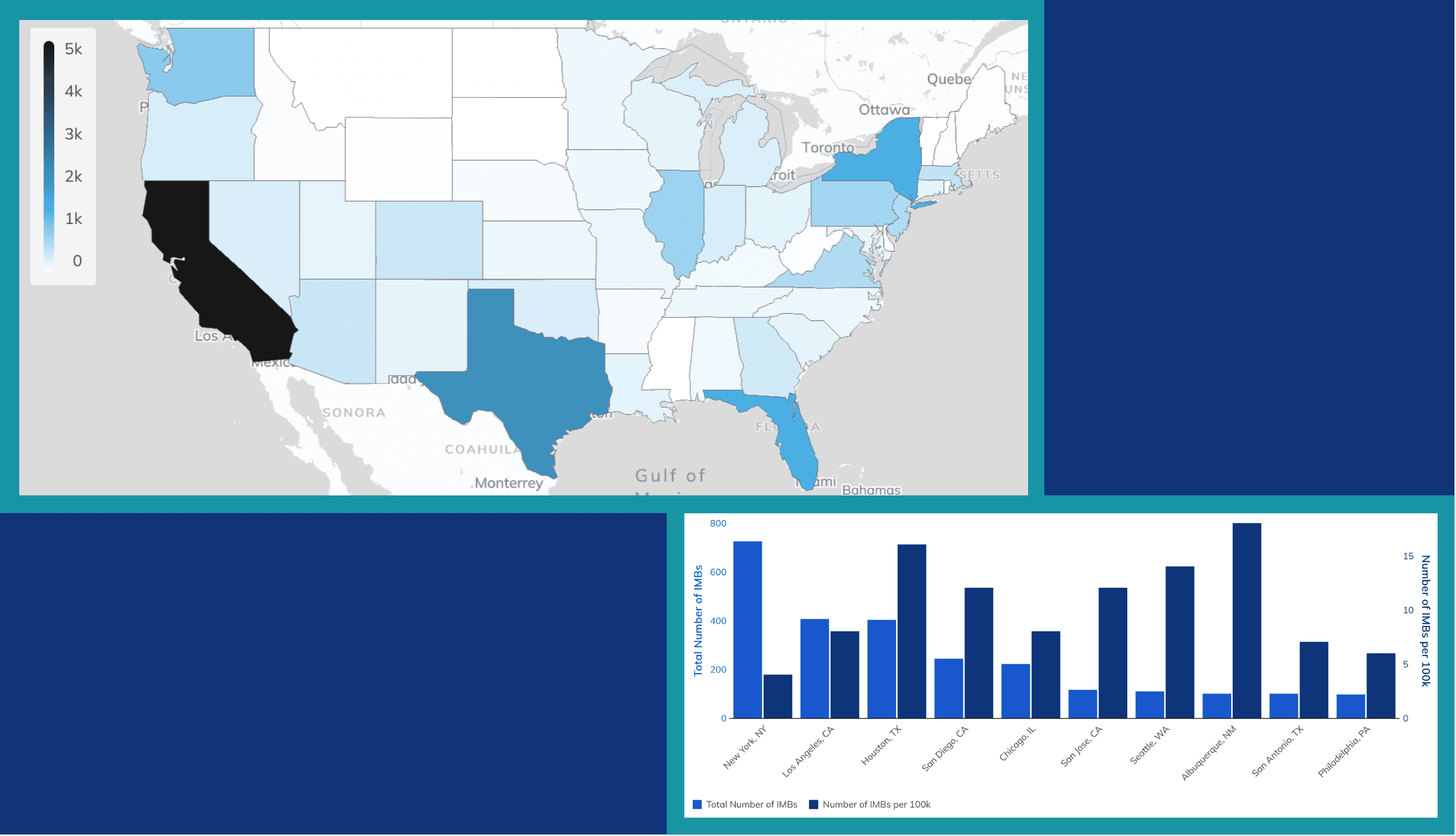
By total count, the pattern is familiar: the most populous states have the most IMBs. California has over 4,000. Texas has approximately 1,700. Florida has approximately 1,200.
States with the lowest totals include Mississippi (13), Rhode Island (15), and South Dakota (16).
But raw counts reflect scale, not intensity. When normalized per 100,000 residents, the rankings shift. The states with the highest IMB concentration per capita are California, Washington, New Mexico, Nevada, and Oregon. The lowest are Mississippi, Rhode Island, North Carolina, West Virginia, and Michigan.
An Interesting Divergence: North Carolina
One of the most striking findings from integrating datasets is the divergence between online ad data and IMB data in North Carolina.
North Carolina ranked among the highest concentration states for online commercial sex advertisements. Both in total volume and per capita, it consistently appeared in the top tier.
But for IMBs, North Carolina ranks among the lowest concentration states per capita.
This suggests that different trafficking markets operate differently in different geographies. Online commercial sex and storefront-based exploitation do not necessarily overlap. A state can be a hotspot for one and not the other. This is exactly the kind of insight that emerges only when you look at multiple datasets together.
City-Level Patterns
By total count, the top three cities with the most IMBs are not surprising: New York, Los Angeles, and Houston.
But when normalized for population, the rankings change. Albuquerque, Houston, Seattle, San Diego, and San Jose emerge as the cities with the highest per capita IMB concentration.
This matters for targeting. Local task forces, state attorneys general, and city regulators need to know not just which cities have the most IMBs, but which cities have the highest density relative to their size. That is where intervention can have the greatest proportional impact.
Demand Reduction Through Risk Creation
During the webinar Q&A, an attendee asked about the best way to disrupt demand. Hassell offered a framework that reframed the question.
The conventional approach asks: can we reduce the total number of sex buyers? Hassell proposed a different lens: can we increase the risk associated with buying sex?
He used an analogy. 18-year-olds have high demand for alcohol, and supply is abundant. Yet it is relatively rare for an 18-year-old to walk into a liquor store and buy a bottle. Not because demand was reduced, but because the marketplace creates risk. People respond to risk every day, whether it is wearing seatbelts, driving the speed limit, or choosing not to smoke.
The same principle applies to the commercial sex market. IMBs are, as Hassell described, “the safest place in America to buy sex today.” The sign says massage. No one asks questions. When The Network works with attorneys general and district attorneys to close these storefronts, the risk for buyers goes up. They can go elsewhere, but every alternative carries more exposure.
Dr. Greg Bott reinforced this with local evidence. The West Alabama Human Trafficking Task Force has conducted demand-focused sting operations in Tuscaloosa for five years, resulting in measurable reductions in buying activity. Sex buyers have explicitly warned each other to avoid the area. As Bott noted, “They have learned through the media exposure from these sting operations that this is not the place, and demand is reduced because risk is increased.”
Strategic Implications
Four strategic implications emerge from the IMB data.
Venue-based targeting works. Since 2021, The Network has enabled state attorneys general and county district attorneys to target and close IMBs through novel tactics involving landlord engagement and code enforcement. These approaches reduce the traditional investigative and prosecutorial burden.
Detection gaps signal system weaknesses. When IMB density is high but hotline reports and prosecutions are low, that misalignment may indicate under-identification, limited investigative focus, or lack of prosecutorial interest. Anecdotally, The Network has learned that prosecutors and law enforcement are often reluctant to pursue IMB cases due to their complexity.
Regulatory evaluation matters. High IMB proliferation in certain jurisdictions may reflect weaknesses in business licensing, zoning enforcement, or inspection regimes. The Network advises jurisdictions on statutory best practices for reducing IMB proliferation.
Resource allocation can be data-driven. IMB clusters identify where outreach, victim services, and law enforcement capacity should be concentrated geographically.
Explore Your State’s IMB Data
Every state profile in the report includes a dedicated page on illicit massage businesses, including total count, per capita rates, and top cities.
Partner With Us
The Network works with state and federal partners to close IMBs and reduce the demand that fuels them. Allies Against Slavery integrates IMB data with other datasets through Lighthouse to provide a complete picture of trafficking indicators.
If your organization works in law enforcement, regulation, victim services, or policy and wants to address the illicit massage industry in your jurisdiction, we want to hear from you.
Learn about partnership opportunities
Together, we can close the storefronts that hide exploitation in plain sight.
See Your State’s IMB Data
How many illicit massage businesses are operating in your state?