What 2,500 Federal Prosecutions Tell Us About How America Fights Trafficking
Mar 16, 2026
Federal prosecution data does not tell us how much trafficking exists. It tells us what the justice system chooses to pursue.
That distinction matters. Because when you look at two decades of federal trafficking cases, a clear picture emerges: the system prioritizes certain types of trafficking over others, certain victims over others, and certain geographies over others.
This is the third post in our series on the 2026 State Human Trafficking Report. It focuses on the federal prosecution dataset, analyzed by Eva Garrido, Allies Against Slavery’s Research and Impact Analyst. The dataset includes 2,561 cases from 2000 to 2023, with over 200 variables coded per case.
How the Dataset Is Built
The team uses a rigorous two-phase process. First, they search case law databases, primarily Bloomberg Law, using targeted keyword queries to identify trafficking-related prosecutions. These include core trafficking statutes as well as related charges like sexual exploitation of children and harboring undocumented individuals.
False positives are removed. Each remaining case is staged for in-depth review. The team collects indictments, complaints, sentencing memos, and news coverage to confirm each case is trafficking-related.
In the coding phase, trained researchers enter over 200 variables per case into the Lighthouse Data platform. These include defendant and victim demographics, trafficking type, geographic data, sentencing outcomes, and more.
The key limitation: this data reflects selection bias. Cases that are easier to prove, that carry harsher penalties, or that generate more public sympathy are more likely to be prosecuted.
Minor Sex Trafficking Dominates the Federal Docket
The clearest pattern in the data is this: minor sex trafficking cases outnumber adult sex trafficking and labor trafficking cases combined, by more than two to one.
There are three reasons for this. First, minor sex trafficking cases do not require proof of force, fraud, or coercion. Second, sentencing guidelines are harsher, creating a stronger incentive for prosecutors. Third, there is greater public concern and sympathy for minor victims.
Garrido explained: “Federal prosecution data reflects what is chosen to be prosecuted, not the prevalence of trafficking.”
This skew shapes how we understand trafficking as a country. If the federal docket is the primary lens, it looks like trafficking is overwhelmingly about minors exploited for sex. The hotline data and other indicators suggest a more complex reality.
Labor Trafficking: Fewer Cases, Far More Victims
Labor trafficking makes up only 8% of federal cases. But when you look at victim counts, the contrast is dramatic.
Labor trafficking cases average 28 victims per case. Minor sex trafficking cases average 3.
This means a small number of labor cases can involve a large number of victims, often foreign nationals recruited abroad and brought into the U.S. In fact, 95% of labor trafficking victims in the dataset are from other countries, compared to 77% of minor sex trafficking victims who are U.S. citizens.
85% of labor trafficking cases involve international activity, while 95% of minor sex trafficking cases occur within U.S. borders.
These are fundamentally different trafficking patterns that require different investigative approaches, different service models, and different policy responses. Yet the enforcement system heavily favors one over the other.
Geographic Patterns Follow Population, Mostly
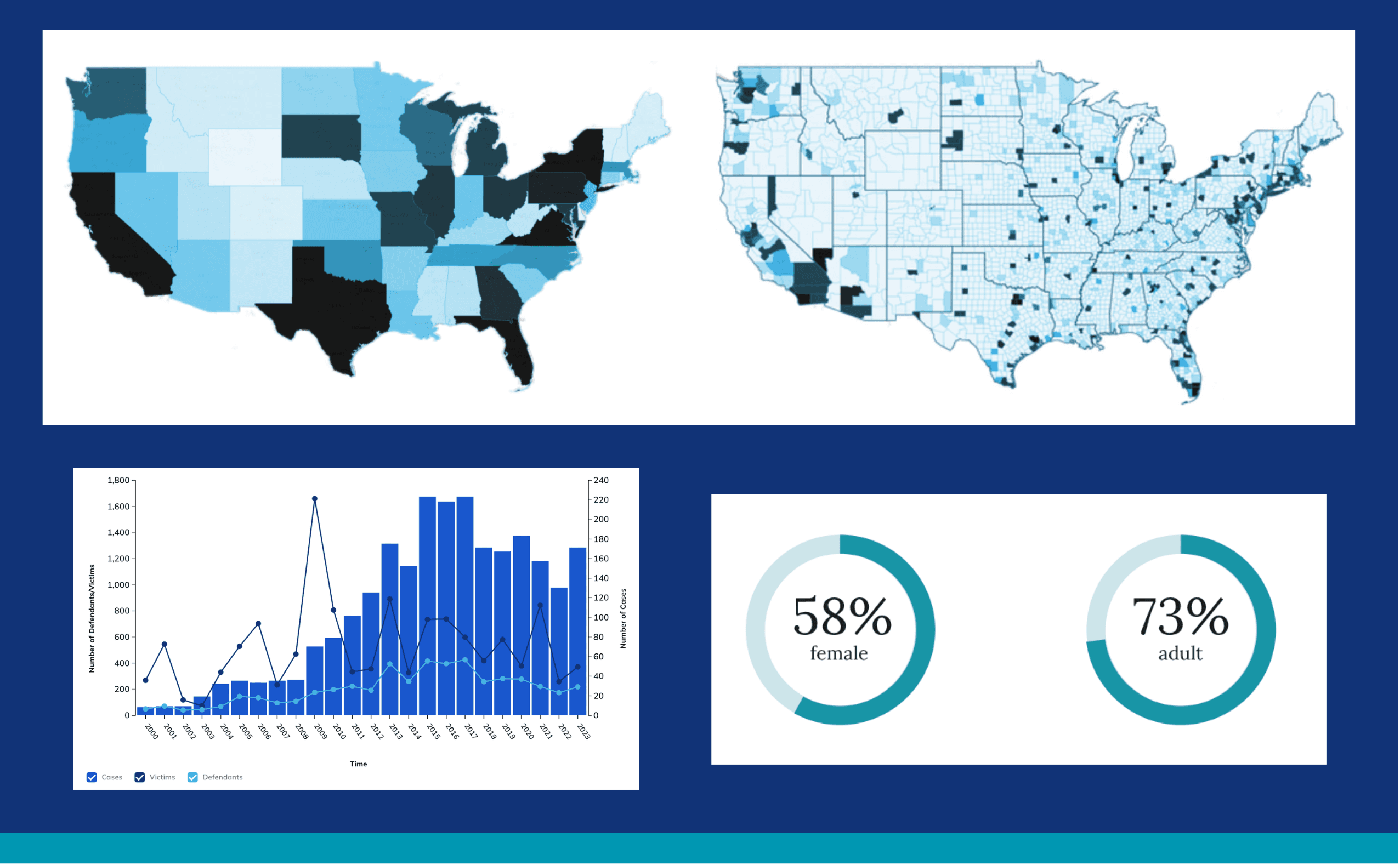
The most populous states lead in total prosecutions: California (234 cases), Texas (229), Florida (220), and New York (202).
But the report is designed to let you look beyond raw counts. Each state’s profile page shows the number and type of cases prosecuted, so you can see whether federal enforcement in your state matches the trafficking indicators.
Some states show clear misalignment. A state with high ad volume and high IMB counts but very few federal prosecutions may signal limited investigative capacity, prioritization of other crimes, or weak referral pathways between state and federal agencies.
Who Are the Defendants and Victims
The dataset provides a demographic picture, though one shaped by the same selection biases that affect the rest of the data.
Among defendants, 46% are Black. The gender ratio is approximately 3 males to 1 female. The average age at arrest is 34, rising to 40 in labor trafficking cases.
Among the 12,505 victims identified across all cases, 58% are female, 5% are male, and 37% are of unknown gender. In labor trafficking cases, there are twice as many male victims as female, though 83% of victims are unidentified, reflecting that large-scale cases often report only estimated victim counts.
72% of all victims are adults. 28% are minors. In labor trafficking cases, 98% are adults.
The most common victim characteristics, in cases where this information was available, were drug or alcohol addiction, homelessness or poverty, and a romantic relationship with a defendant.
What This Means for the Field
Prosecution data is not a measure of trafficking prevalence. It is a measure of system response. And that response has clear patterns.
The federal system prioritizes minor sex trafficking cases. Labor trafficking is severely underrepresented relative to its scale. Geographic patterns largely follow population, but some states have enforcement gaps that deserve attention.
When this prosecution data is layered with hotline data, online ad data, IMB data, and policy data, the gaps become even more visible. That is the value of the integrated approach the State Human Trafficking Report provides.
During the webinar, multiple attendees asked about state-level prosecution data. The team acknowledged this as a critical gap. State prosecution data currently exists for Texas, Louisiana, and Florida through Lighthouse partnerships, but expanding to other states is a goal.
Explore Your State’s Prosecution Data
Every state profile in the report includes a full page on federal trafficking prosecutions, including case counts by type, geographic patterns, and trend data.
Partner With Us
If your organization works in prosecution, law enforcement, or criminal justice research, and you want to contribute to a more complete picture of trafficking enforcement across the country, we want to hear from you.
Learn about partnership opportunities
Together, we can build a justice system response that reflects the full scope of trafficking in America.
See Your State's Federal Prosecution Data
How does federal trafficking enforcement in your state compare to the national picture?