
The Prevention Gap: What 25 Anti-Trafficking Policies Reveal Across 50 States
Mar 9, 2026
Since 2003, states across the country have been building their anti-trafficking policy frameworks. Some states have passed nearly all 25 policies tracked in the State Human Trafficking Report. Others have adopted closer to half.
But the most striking finding is not about which states are ahead or behind. It is about what the entire country is missing.
States are far better at prosecution than prevention. And labor trafficking policy is almost entirely absent.
This is the second post in our series on the 2026 State Human Trafficking Report, a collaboration between Allies Against Slavery, Polaris, The Network, and the University of Alabama Institute for Data Analytics. This post focuses on the state policy dataset, analyzed by Maddie Moffett, Allies Against Slavery’s Government Affairs Lead.
How the Policy Database Works
The State Human Trafficking Policy Database tracks the adoption of 25 specific anti-trafficking policies across all 50 states from 2003 to 2024. The methodology is straightforward. The team conducts systematic searches of state legislative portals and legal research databases. Each law is reviewed against standardized definitions in a policy glossary. Policies are coded in binary: adopted or not adopted.
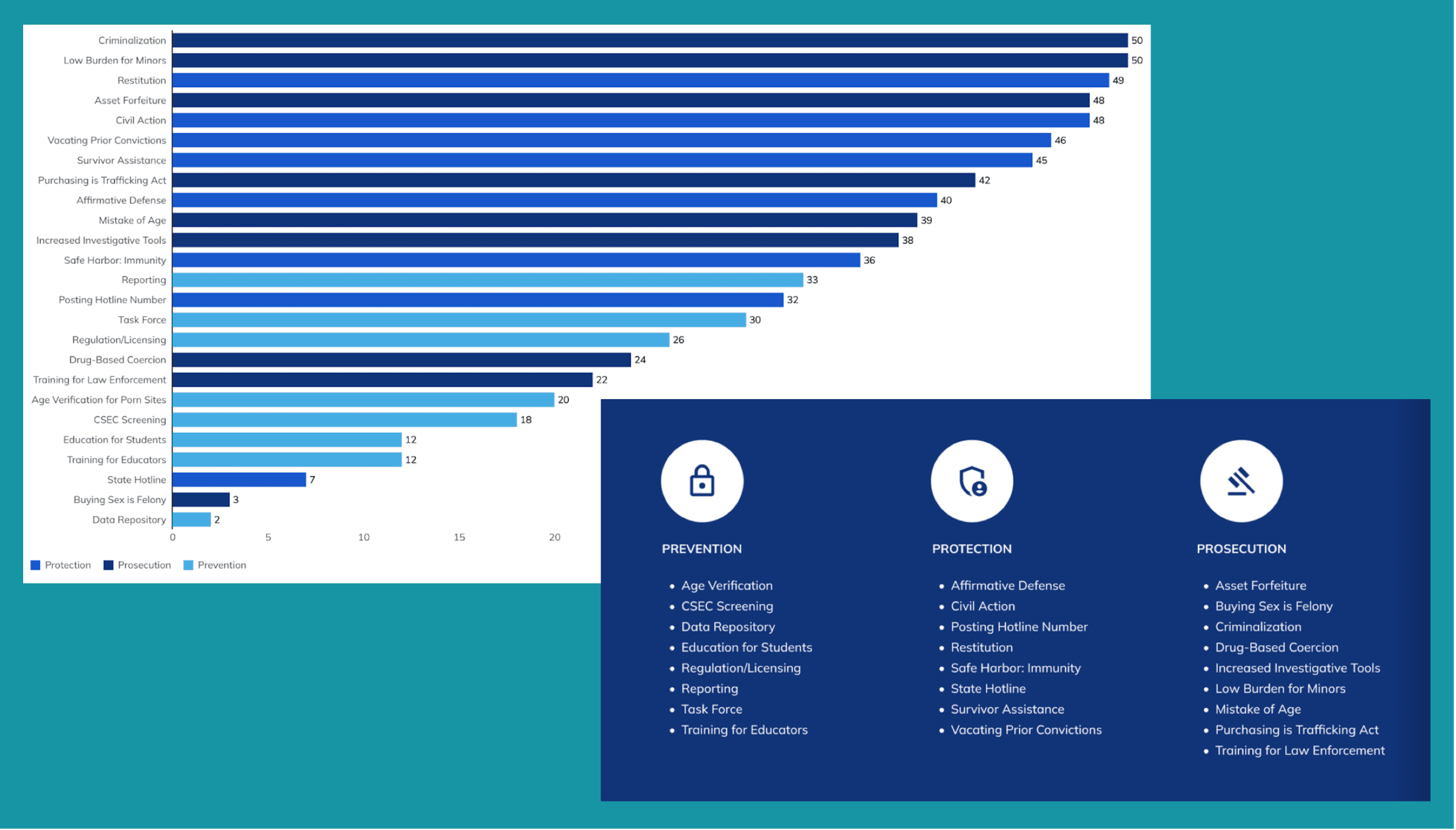
The 25 policies are grouped into three categories: 8 prevention policies, 8 protection policies, and 9 prosecution policies.
This year, five new policies were added: data repository legislation, age verification of pornographic sites, hotline creation, penalties for buying sex, and drug-based coercion.
An important limitation: the database measures policy adoption, not implementation or effectiveness. The presence of a law does not mean the law is working.
The National Prevention Gap
Here is the headline finding. Across the country, states have passed 316 prosecution-related policies and 303 protection-related policies among the categories tracked.
But only 153 prevention measures have been enacted.
That means for every two prosecution or protection policies passed, roughly one prevention policy exists. Prevention is not just lagging. It is structurally underrepresented in state anti-trafficking frameworks.
Moffett called this “one of the most significant national findings.”
Why does this matter? Because prosecution responds to trafficking after it happens. Prevention stops it before it starts. If the national goal is to reduce trafficking, not just respond to it, prevention policy needs to catch up.
Labor Trafficking Policy Is Nearly Nonexistent
The report categorizes each policy by whether it addresses sex trafficking, labor trafficking, or both. Some policies are specific to sex trafficking, like safe harbor provisions and CSA screening mandates. Others apply to both types, like criminalization and restitution.
But here is the gap: none of the 25 tracked policies pertain only to labor trafficking.
California passed a Supply Chain Transparency Act in 2010. In the 14 years since, not a single state has followed suit with comparable labor-specific policy.
This mirrors what we see in other datasets. Labor trafficking makes up only 8% of federal prosecutions. It was historically underrepresented in hotline data before recent gains. And policy frameworks reflect that same blind spot.
Sentencing Varies Widely by Trafficking Type
The dataset also examines sentencing minimums and maximums across states. The findings show meaningful variation.
The average statutory minimum for trafficking a minor for commercial sex is just over 8 years. For trafficking a minor for forced labor, it is approximately 5 years. Maximum penalties follow the same pattern: roughly 74 years for minor sex trafficking versus 66 for minor labor trafficking.
38% of states have no mandatory minimum for adult sex trafficking. 36% have no mandatory minimum for labor trafficking of a minor. At the same time, 56% of states authorize life imprisonment as a maximum for minor sex trafficking.
The takeaway: there is a clear sentencing prioritization of minor sex trafficking. That prioritization reflects broader patterns across the entire criminal justice system’s response to trafficking.
Which States Lead in Policy Adoption
Policy adoption varies substantially by state. Florida and Texas have enacted 22 of the 25 tracked policies. Several states remain closer to 10.
The report does not rank or grade states. Instead, each state’s profile page provides a detailed breakdown of which policies have been passed and which have not, including the specific statute citation for every enacted policy.
This makes the report a practical tool. A policymaker in any state can see exactly what their state has and has not adopted, compare it to other states, and identify specific legislative gaps.
What This Means for the Field
During the webinar Q&A, an attendee asked whether the report assesses how effective these policies are in practice. The honest answer: not yet.
Moffett explained that the dataset measures statutory adoption, not implementation or enforcement. But that is exactly the point. Understanding where policies exist is the foundation. Once that map is clear, the field can begin asking the harder questions about what is actually working.
The integration of policy data with the other four datasets in the report makes those questions more answerable. If a state has strong policy but low prosecution activity, that tells you something. If prevention policy is absent but demand indicators are high, that tells you something else.
Explore Your State’s Policy Profile
Every state in the report includes a dedicated policy page showing which of the 25 policies have been adopted, when they were passed, and the specific statutory citation.
Partner With Us
Allies Against Slavery’s policy program works with state partners to advocate for data-driven anti-trafficking legislation. If your state has gaps in its policy framework, or if you want to strengthen existing laws with evidence, we want to work with you.
Learn about partnership opportunities
Together, we can close the prevention gap and build policy frameworks that actually reduce trafficking.
See Your State’s Policy Scorecard
Find out which anti-trafficking policies your state has adopted and where the gaps are