What Five National Datasets Reveal About Human Trafficking in Every State
Mar 2, 2026
Twenty-six years ago, the Trafficking Victims Protection Act established the foundation for America's response to human trafficking. Since then, every state has passed anti-trafficking legislation. Federal prosecutors have brought thousands of cases. The National Human Trafficking Hotline has fielded hundreds of thousands of reports.
Yet until recently, no single resource brought all of that information together. No report let you see what was happening across prevention, protection, and prosecution in your state, backed by multiple sources of national data.
That changed with the State Human Trafficking Report. And this year, the report got significantly more powerful.
Why This Report Matters
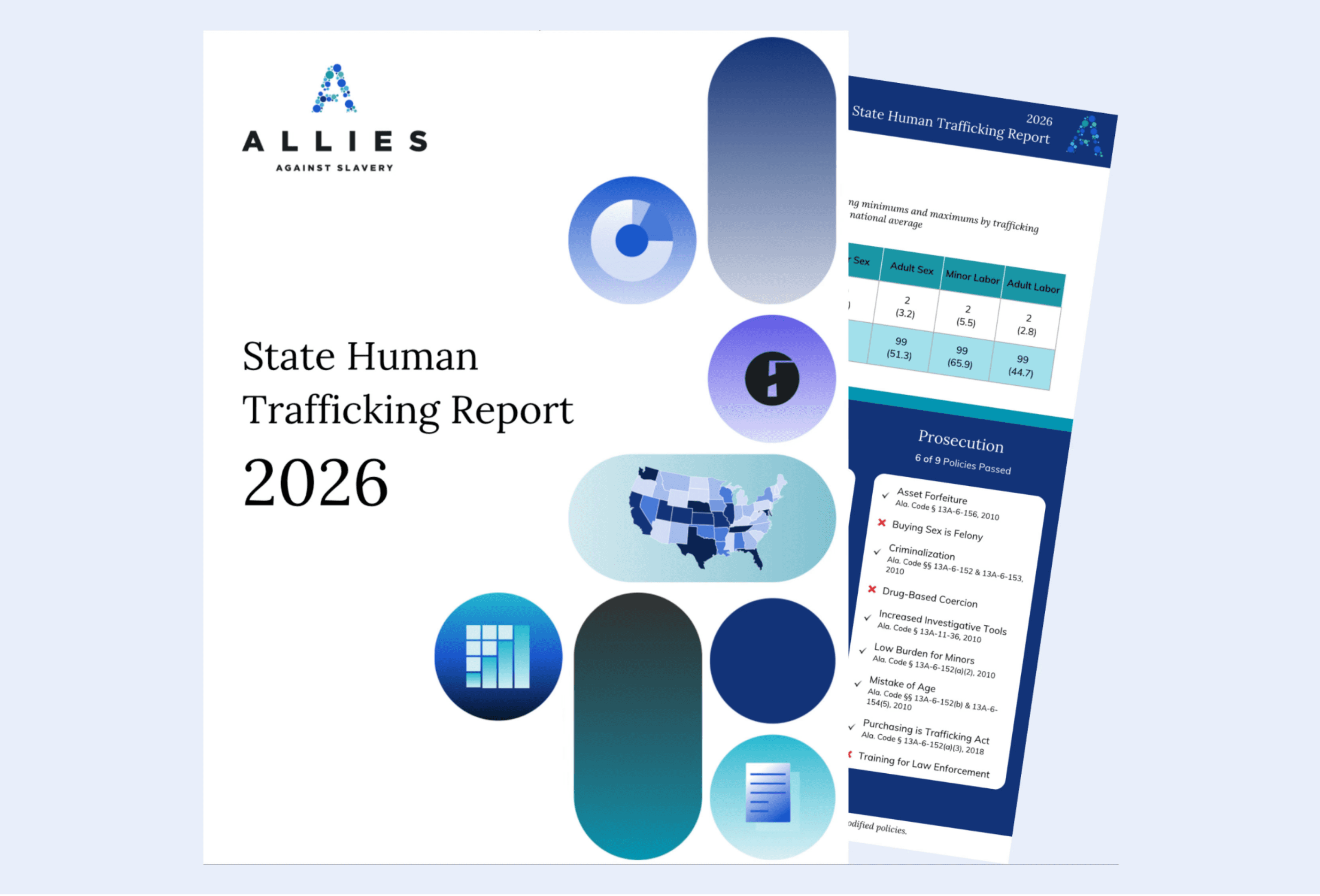
The 2026 State Human Trafficking Report is the most comprehensive analysis of human trafficking data across all 50 states. It is the product of a partnership between four organizations: Allies Against Slavery, Polaris, The Network, and the University of Alabama Institute for Data Analytics.
This year, the report expanded from two national datasets to five:
State anti-trafficking policies (2003–2024)
Federal human trafficking prosecutions (2000–2023)
National Human Trafficking Hotline situations (2007–2024)
Online commercial sex advertisements (2024)
Illicit massage businesses (2024)
No single dataset tells the full story. But when you layer them together, patterns emerge that no one source can reveal on its own. You can see whether a state’s policy framework translates into enforcement. You can compare demand signals against prosecution activity. You can identify where reporting is strong but prosecution is weak, or where trafficking indicators are high but reporting is low.
As Vanessa Bouché, Chief Impact Officer at Allies Against Slavery, shared during the webinar: “Strategy lives in understanding where systems are working and where they’re not, and where targeted intervention will have the greatest impact.”
More than 650 leaders from 42 states registered for the report’s launch webinar. They represented nonprofits, government agencies, academic institutions, law enforcement, and lived experience experts. The demand for this kind of integrated intelligence is clear.
What the Data Reveals: Key Findings
Here is a look at what each dataset uncovered, and why it matters.
States Are Prosecuting More Than They’re Preventing
Maddie Moffett, Allies Against Slavery’s Government Affairs Lead, analyzed 25 anti-trafficking policies across all 50 states from 2003 to 2024.
The headline finding: there is a significant gap between prosecution-focused policy and prevention-focused policy. Across the country, states have passed 316 prosecution-related policies and 303 protection-related policies. But only 153 prevention measures have been enacted.
The labor trafficking policy gap is equally stark. Among the 25 policies tracked, none are specific to labor trafficking. California passed a Supply Chain Transparency Act in 2010. Not a single state has followed suit.
Moffett noted: “This prevention policy gap remains one of the most significant national findings.”
Minor Sex Trafficking Dominates Federal Prosecutions
Eva Garrido, Allies Against Slavery’s Research and Impact Analyst, analyzed more than 2,500 federal human trafficking prosecutions from 2000 to 2023.
The clearest trend: minor sex trafficking cases outnumber adult sex trafficking and labor trafficking cases combined, by more than two to one. That is not because minor sex trafficking is the most common form of trafficking. It is because these cases have a lower burden of proof, harsher sentencing guidelines, and greater public sympathy.
Meanwhile, labor trafficking makes up only 8% of federal cases, yet those cases average 28 victims each, compared to 3 per minor sex trafficking case.
Garrido explained: “Federal prosecution data reflects what is chosen to be prosecuted, not the prevalence of trafficking.”
Labor Trafficking Is Rising in Hotline Reports
Megan Lundstrom, CEO of Polaris, shared trends from 102,555 trafficking situations reported to the National Human Trafficking Hotline between 2007 and 2024.
Two shifts stand out. Labor trafficking situations reported to the hotline rose from 15% in 2015 to 22% in 2024. And male potential victims increased from 4% to 9% over the same period. Both trends likely reflect improved recognition, not increased victimization.
Lundstrom highlighted an important comparison: “Federal prosecution trends are more skewed towards minor victims, while cases reported to the hotline skew towards reporting adult victims.” That gap between what the hotline sees and what federal courts prosecute is exactly the kind of insight this report was designed to surface.
19 Million Ads Reveal Persistent Demand
Dr. Greg Bott, Associate Professor at the University of Alabama Institute for Data Analytics, shared findings from 19.3 million online commercial sex advertisements scraped from three major websites in 2024.
More than 50,000 unique ads were captured daily. The national average held steady at 1.6 million ads per month.
By total volume, California, Florida, and Texas led. But when normalized for population, Connecticut, South Carolina, and Virginia emerged as high-intensity states. At the city level, Jacksonville and Charlotte ranked just behind New York City.
Dr. Bott put it plainly: “Raw totals indicate market size. Normalized rates indicate high demand relative to population.”
More IMBs Than McDonald’s
Ian Hassell, CEO of The Network, presented data on 17,276 illicit massage businesses identified nationwide in 2024.
There are more illicit massage business storefronts in the United States than there are McDonald’s locations. The industry generates an estimated $5 billion annually.
When normalized by population, California, Washington, New Mexico, Nevada, and Oregon had the highest IMB concentration. Interestingly, North Carolina ranked among the highest states for online ads but among the lowest for IMBs, suggesting that different trafficking markets operate differently in different geographies.
Hassell offered a compelling framework: “People are responsive to risk. Not every sex buyer will always buy sex in every venue. They’re actually really sensitive to risk.”
The Power of Integration
Each dataset has value on its own. The real breakthrough is what they reveal together.
When ad volume is high in a state but hotline reports and prosecutions are low, that signals potential under-detection. When a state has strong policy but weak enforcement, that signals an implementation gap. When hotline data shows rising labor trafficking reports but federal prosecution data shows almost none, that reveals where the system is falling short.
This kind of cross-dataset analysis is new for the anti-trafficking field. It is made possible because four organizations agreed to share data, align on methodology, and publish together.
Explore Your State
The full report includes a four-page profile for every state, covering all five datasets.
Partner With Us
This report is the product of collaboration. And we want to expand it.
If today’s findings sparked ideas about how your organization could contribute data, inform policy, or strengthen local responses, we want to hear from you. Whether you are a state agency, a service provider, a research institution, or a funder, there are ways to work together.
Learn about partnership opportunities
Together, we can build a future where every community has the data it needs to combat and prevent human trafficking.
Explore Your State's Data
Download the full report or explore the interactive state-by-state map