

In Organized Crime and Human Trafficking in the United States, published in the Journal of Human Trafficking (2026), the authors challenge one of the most enduring assumptions in anti-trafficking policy—that human trafficking is primarily controlled by large, sophisticated transnational organized crime groups. Drawing on an analysis of more than 2,390 federally prosecuted U.S. human trafficking cases from 2000 to 2022, the study provides one of the largest empirical examinations to date of the relationship between organized crime and trafficking.
At the center of the article is the introduction of a new 5-S typology that classifies organized crime groups according to five key dimensions: size, scope, sophistication, structure, and self-identification. These characteristics are used to distinguish five organizational types: Mom & Pop operations, Crime Rings, Gangs, Illegal Enterprises, and Cartels/Mafia/Syndicates. Rather than treating organized crime as a single, uniform concept, the framework recognizes that criminal organizations exist along a spectrum of organizational complexity and coordination.
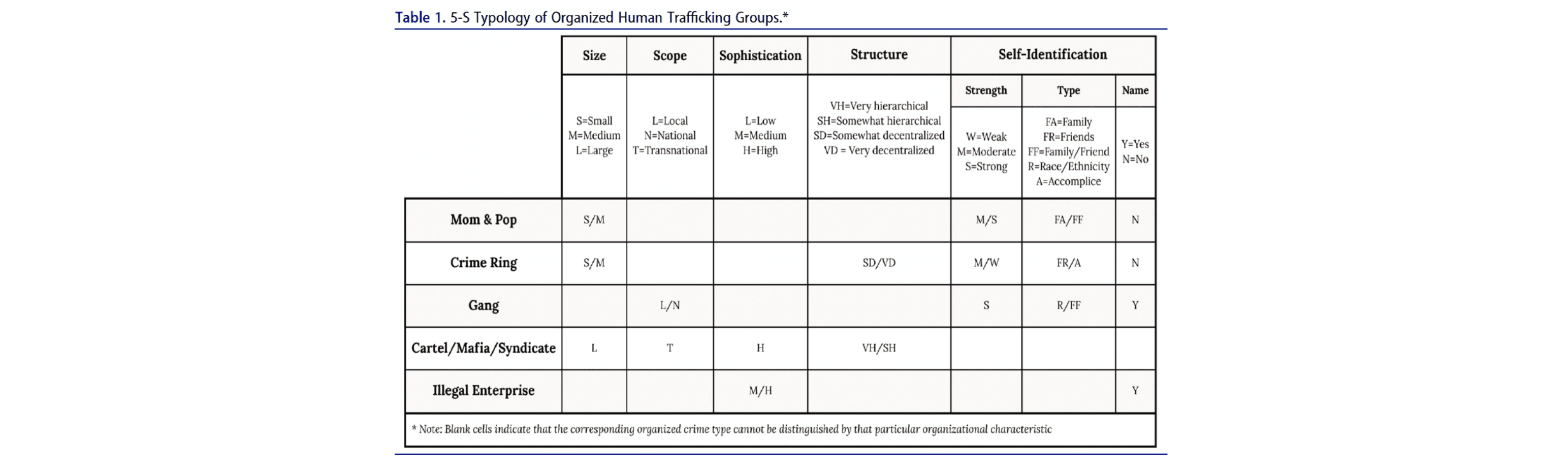
Applying this typology to federal prosecution data reveals a striking finding: 67% of prosecuted trafficking cases involved individuals or groups that did not meet the criteria for organized crime. Among the cases that did involve organized crime, the overwhelming majority were small-scale Crime Rings or Mom & Pop operations, while highly structured Cartels or Syndicates accounted for only a small fraction of cases. These findings challenge the dominant narrative that trafficking in the United States is largely orchestrated by powerful international criminal organizations.
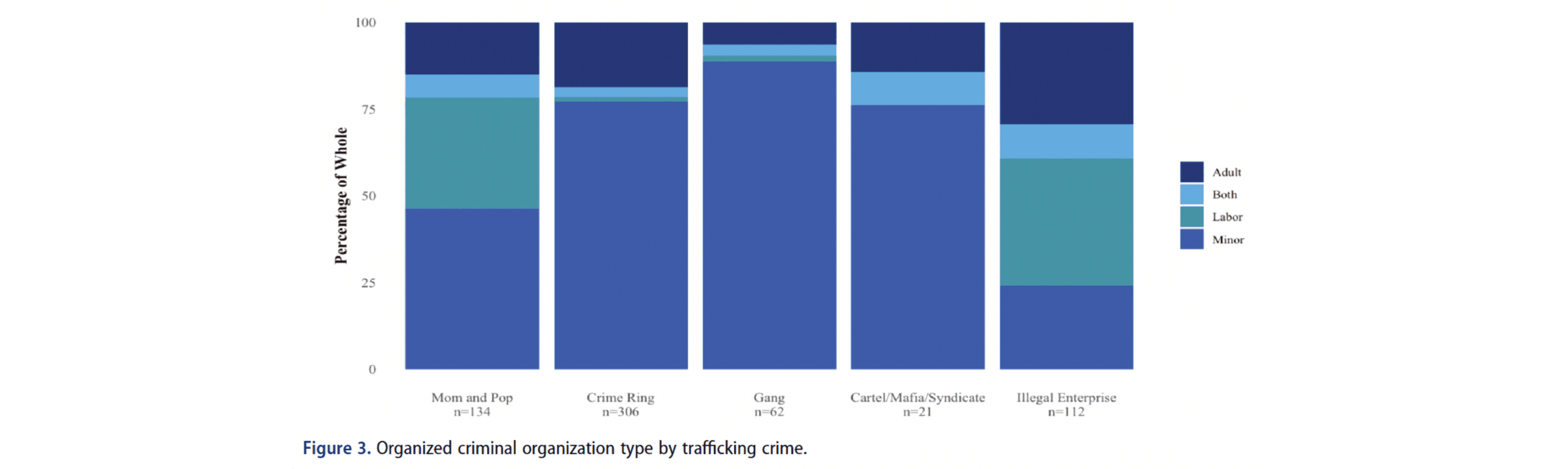
The analysis also uncovers important differences across trafficking types. Minor sex trafficking cases were most commonly associated with smaller, localized, and less sophisticated organizations. Labor trafficking, by contrast, was significantly more likely to involve organizations with broader geographic reach, stronger internal cohesion, and higher levels of sophistication—particularly Illegal Enterprises operating through business-like structures. Although Illegal Enterprises represented relatively few prosecuted cases, they accounted for the majority of identified victims, suggesting that they produce substantially greater harm on a per-case basis than other organizational forms.
Beyond its empirical findings, the article offers an important conceptual contribution by providing researchers and practitioners with a practical framework for consistently measuring and comparing organized crime across trafficking cases. The authors also acknowledge the limitations of prosecution data, noting that federal cases reflect patterns of detection and prosecutorial priorities rather than the complete universe of trafficking activity. As a result, the study emphasizes that its findings describe the organizational structures most visible within federal prosecutions—not necessarily the prevalence of organized crime across all trafficking.
Ultimately, the article argues that effective anti-trafficking strategies require a more nuanced understanding of how trafficking organizations actually operate. By replacing broad assumptions with empirical evidence, the 5-S typology provides policymakers, researchers, and law enforcement with a stronger foundation for tailoring interventions, allocating resources, and developing more targeted responses to different forms of human trafficking.
Explore our public insights
View the trends outlined in this publication and more on our public insights website. This platform gives you a taste of the data available on Lighthouse.