
In Behind the Screen: Online Sex Buyer Networks and the Organized Criminal Promotion of Exploitation, published in Dignity: A Journal of Analysis of Exploitation and Violence (2026), the authors examine whether online sex buyer communities in the United States function as organized criminal groups. Rather than treating buyers as isolated individuals, the study analyzes the forum as a digital ecosystem in which participants repeatedly communicate, share intelligence, reinforce norms, and help one another navigate the illegal commercial sex market.
The study applies the United Nations Convention against Transnational Organized Crime definition, which describes an organized criminal group as a structured group of three or more people that exists over time, acts in concert to commit serious offenses, and seeks financial or material benefit. The authors test these elements through three questions: whether buyers form persistent and structured communities, whether they coordinate to facilitate criminal activity, and whether their information-sharing helps them reduce losses and obtain material benefits.
To answer these questions, the researchers analyzed 1,200,346 posts made between April 2018 and December 2024 on a publicly accessible U.S. sex buyer forum. The dataset included 72,974 unique users and 789,929 direct replies. Social network analysis identified more than 15,000 user communities with at least five members, as well as 73 interconnected city-level communities. Central users operated as influential hubs, helping circulate information and reinforce the norms of their networks.
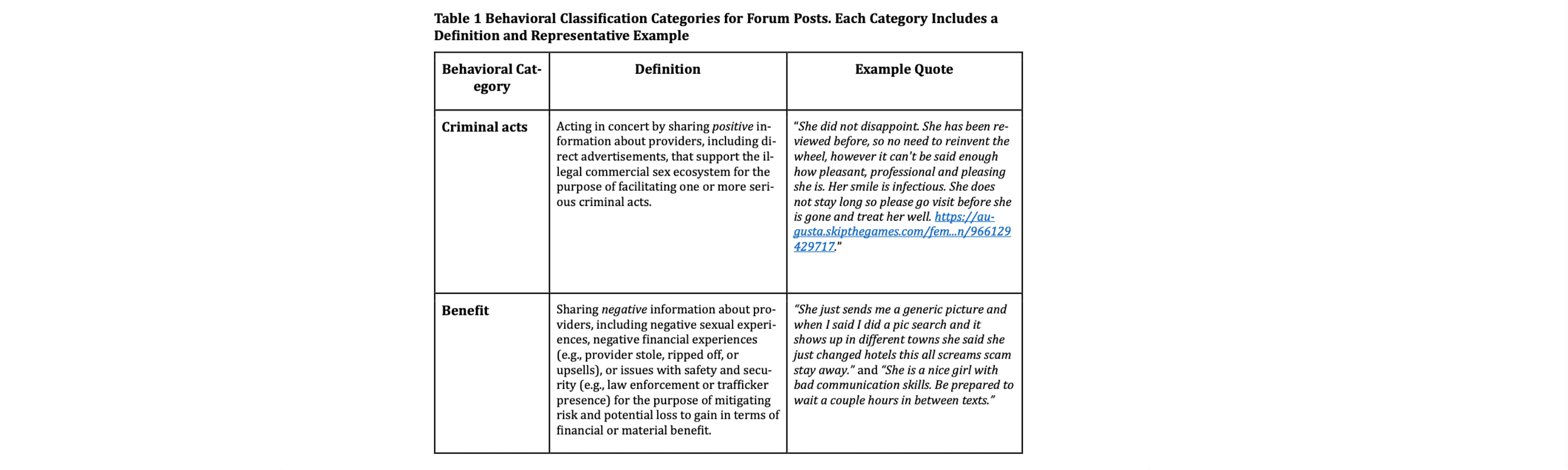
Machine-learning text classification also showed that forum content was operational, not merely conversational. At the user and community levels, the model estimated a 31.7% likelihood that posts contained “criminal acts” content, including endorsements, advertisements, links, and logistical guidance that facilitated illegal commercial sex. The model estimated a 64.9% likelihood that posts contained “benefit” content: warnings and negative reviews intended to reduce financial, legal, reputational, or physical risk. These risk-mitigation communities were larger and more influential than the networks centered on positive promotion.
Taken together, the findings support all three hypotheses and lead the authors to conclude that the forum meets the United Nations criteria for an organized criminal group. The article argues that online sex buyer communities function as decentralized but structured criminal infrastructures that sustain demand and normalize exploitation.

The study recommends shifting policy and enforcement toward the networks that organize and protect demand. Potential responses include stronger accountability for buyers who promote or facilitate the market, targeting highly central users, regional coordination across jurisdictions, and more tailored demand-reduction interventions. The authors also note important limitations: the study examines one platform, text classification involves subjective judgments, and the analysis cannot establish whether network density causes facilitative behavior. Even so, the research offers a new empirical framework for identifying and disrupting organized exploitation in digital spaces.
Get access to Lighthouse
Partner with us on Lighthouse Data to glean even more from your state's data sources.