Twenty Years of Anti-Trafficking Policy: What 710 Laws Across 50 States Reveal
Mar 9, 2026
In 2000, the United States passed the Victims of Trafficking and Violence Protection Act. It was the first major update to federal anti-slavery law since 1865. That single law launched a wave of state-level action that continues today.
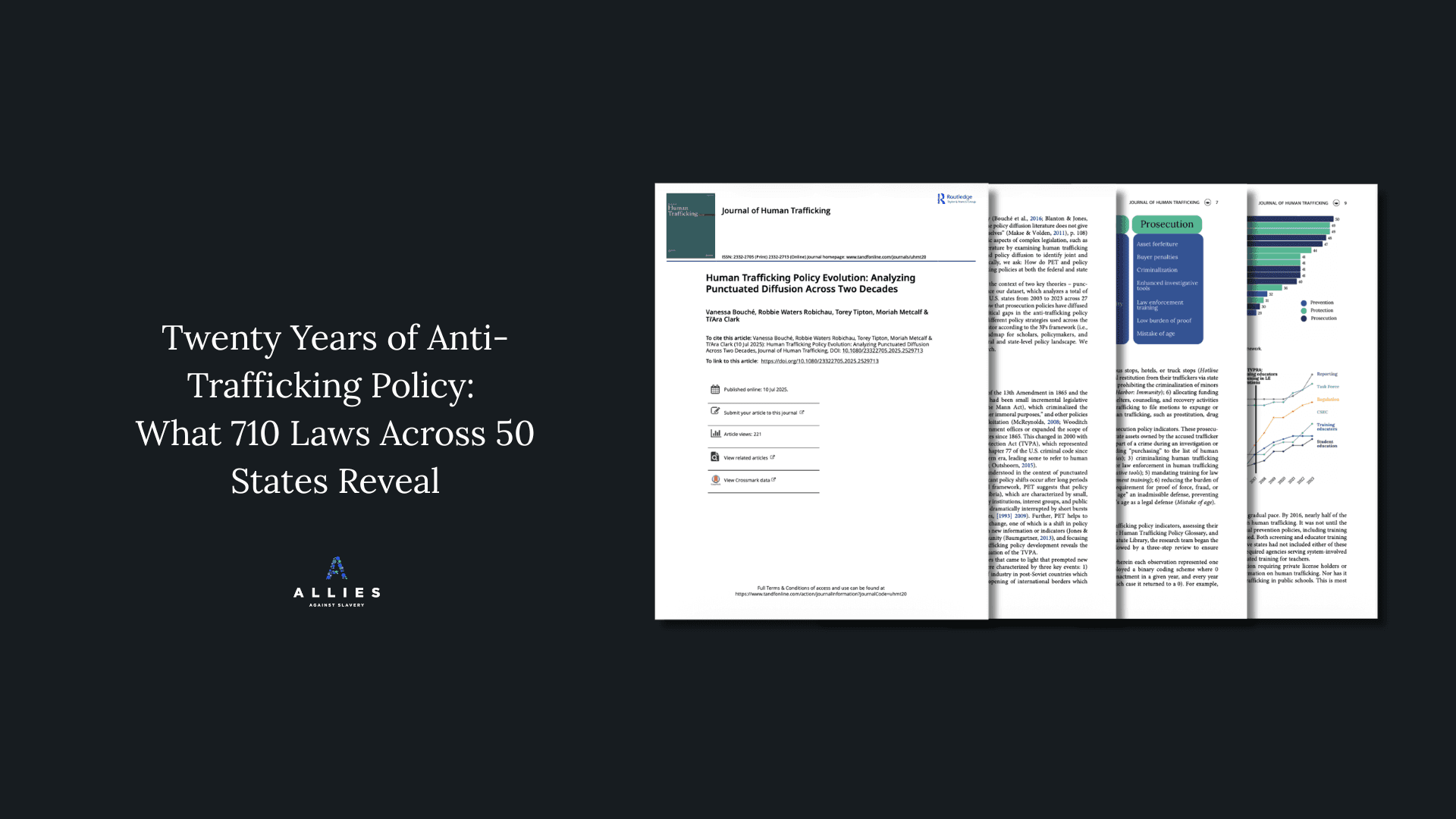
A new peer-reviewed study published in the Journal of Human Trafficking traces that wave across two decades. The research, co-authored by Allies Against Slavery in partnership with scholars from the University of Texas at Austin and Texas A&M University, analyzes 710 pieces of anti-trafficking legislation passed by all 50 states from 2003 to 2023.
The findings reveal clear progress. They also reveal a significant blind spot.
How Allies Against Slavery Contributed to This Research
This study draws on the State Human Trafficking Policy Database, a comprehensive dataset maintained through a long-standing partnership between Allies Against Slavery and the Bush School of Government at Texas A&M University. Allies Against Slavery's Lighthouse Data platform houses the policy data that made this analysis possible.
The research team coded 27 different policy indicators across all 50 states over a 21-year period. That produced 29,700 individual data points. Each policy was then classified using the 3Ps framework: Prevention, Protection, and Prosecution.
What the Data Shows: Prosecution Leads, Prevention Lags
The study's central finding is straightforward. States have prioritized prosecution and protection policies. Prevention has been left behind.
Here is what that looks like in practice. All 50 states have criminalized human trafficking. Forty-nine states provide victims with civil action rights. Forty-nine have restitution laws. Forty-eight allow asset forfeiture in trafficking cases.
But only 16 states require agencies to screen system-involved youth for trafficking. Only 12 mandate training for educators. And just 11 require human trafficking education for public school students.
The pattern is clear. When it comes to holding traffickers accountable and supporting survivors after the fact, most states have acted. When it comes to stopping trafficking before it starts, most states have not.
How Policies Spread: The Punctuated Diffusion Model
The research introduces a concept called "punctuated diffusion" to explain how anti-trafficking policies move across the country. The idea combines two established policy theories.
First, punctuated equilibrium theory explains why big policy changes happen suddenly after long periods of stability. The TVPA in 2000 was exactly that kind of sudden shift.
Second, policy diffusion theory explains how those changes spread from one jurisdiction to another. Sometimes that spread moves vertically, from the federal government down to states. Sometimes it moves horizontally, from state to state.
The study found that early TVPA provisions around criminalization, asset forfeiture, and victim restitution spread quickly from the federal level to states. This is vertical diffusion in action.
But the researchers also found something less expected. In several cases, states moved first and the federal government followed. For example, 30 states had already classified the purchase of trafficking victims as a criminal act before Congress made it federal law in 2015. Thirty-nine states had granted enhanced investigative tools to law enforcement before the federal government did so in 2018. And 41 states now have vacatur laws allowing survivors to clear trafficking-related criminal records, even though Congress has not yet passed its own version.
This two-way flow matters. It shows that states are not just following Washington. They are leading.
Why Prevention Matters Now More Than Ever
The imbalance between prosecution and prevention is not just an academic observation. It has real consequences.
Allies Against Slavery's Lighthouse Screening platform has demonstrated what happens when prevention tools are put in place. In 2025, 186 agencies across Texas and Louisiana used Lighthouse Screening to assess 39,423 youth. Of those, 3,286 were identified as "Clear Concern" for trafficking.
These are young people who might have gone unnoticed without systematic screening. The data from this study confirms that only 16 states currently require this kind of screening. That means thousands of at-risk youth in the remaining 34 states may be falling through the cracks.
The study also highlights a broader trend. The U.S. Department of State's 2024 Trafficking in Persons Report emphasized the role technology and data can play in prevention, from education campaigns to geolocation mapping of trafficking patterns. Allies Against Slavery's work with Lighthouse Data and Lighthouse Screening is a practical example of what that looks like on the ground.
What This Means for the Field
This research offers a roadmap. By mapping 27 policy indicators across all 50 states over 20 years, the study gives policymakers, advocates, and practitioners a clear picture of where their state stands and where gaps remain.
For Allies Against Slavery, the findings reinforce what we have been building toward. Our advocacy for mandatory human trafficking data repositories, our work with Representative Senfronia Thompson to pass universal youth screening in Texas, and our support for the National Human Trafficking Database Act at the federal level are all responses to the prevention gap this research documents.
The study also validates the collaborative approach at the heart of our mission. Anti-trafficking policy does not move in one direction. It moves in many directions at once, shaped by federal action, state innovation, advocacy campaigns, and real-world evidence. Building the data infrastructure to track these movements and identify gaps is exactly what Lighthouse Data was designed to do.
What Comes Next
The researchers note several important limitations. The study tracks whether policies exist. It does not measure whether they work. Almost no research has examined the effectiveness of state anti-trafficking policy. That is the next frontier.
Allies Against Slavery is positioned to help answer that question. With screening data from hundreds of thousands of assessments, policy adoption data across all 50 states, and federal prosecution data spanning two decades, we have the foundation for understanding not just what laws are on the books, but what impact they are having.
The full study, "Human Trafficking Policy Evolution: Analyzing Punctuated Diffusion Across Two Decades," is available in the Journal of Human Trafficking.
Explore human trafficking policy data for your state through the Allies Against Slavery data explorer at alliesagainstslavery.org.
Frequently Asked Questions
How many states have anti-trafficking laws?
All 50 states have criminalized human trafficking as of 2015. However, the comprehensiveness of state laws varies widely. According to research published in the Journal of Human Trafficking analyzing Allies Against Slavery's policy database, prosecution policies are nearly universal while prevention policies remain rare.
What is the 3Ps framework for human trafficking policy?
The 3Ps framework categorizes anti-trafficking policies into Prevention, Protection, and Prosecution. It was established by the Trafficking Victims Protection Act of 2000 and the United Nations Palermo Protocol. Allies Against Slavery uses this framework to track and analyze policy adoption across all 50 states through its Lighthouse Data platform.
Which states lead in anti-trafficking prevention policy?
As of 2023, only 16 states require trafficking screening for system-involved youth, and only 12 mandate training for educators. Prevention policies remain the least adopted category of anti-trafficking legislation nationwide, according to the State Human Trafficking Policy Database maintained by Allies Against Slavery.
What is Lighthouse Data?
Lighthouse Data is Allies Against Slavery's comprehensive data platform that aggregates and visualizes trafficking-related data from multiple national sources. It includes state policy adoption data, federal prosecution records, commercial sex advertisement trends, and screening results, making it the most comprehensive trafficking data platform in the United States.
Explore Your State's Policy Landscape
Use the Allies Against Slavery data explorer to see how your state compares on anti-trafficking policies across prevention, protection, and prosecution. Data-driven insights for advocates, policymakers, and practitioners.