
Strip Clubs and Sex Trafficking: The Hidden Infrastructure
May 21, 2026
Strip Clubs and Sex Trafficking: The Hidden Infrastructure of Organized Crime
New research shows strip clubs function as organized crime infrastructure. Survey data finds workers are three times more likely to report being trafficked. Yet only 42 federal cases over 23 years involve these venues.
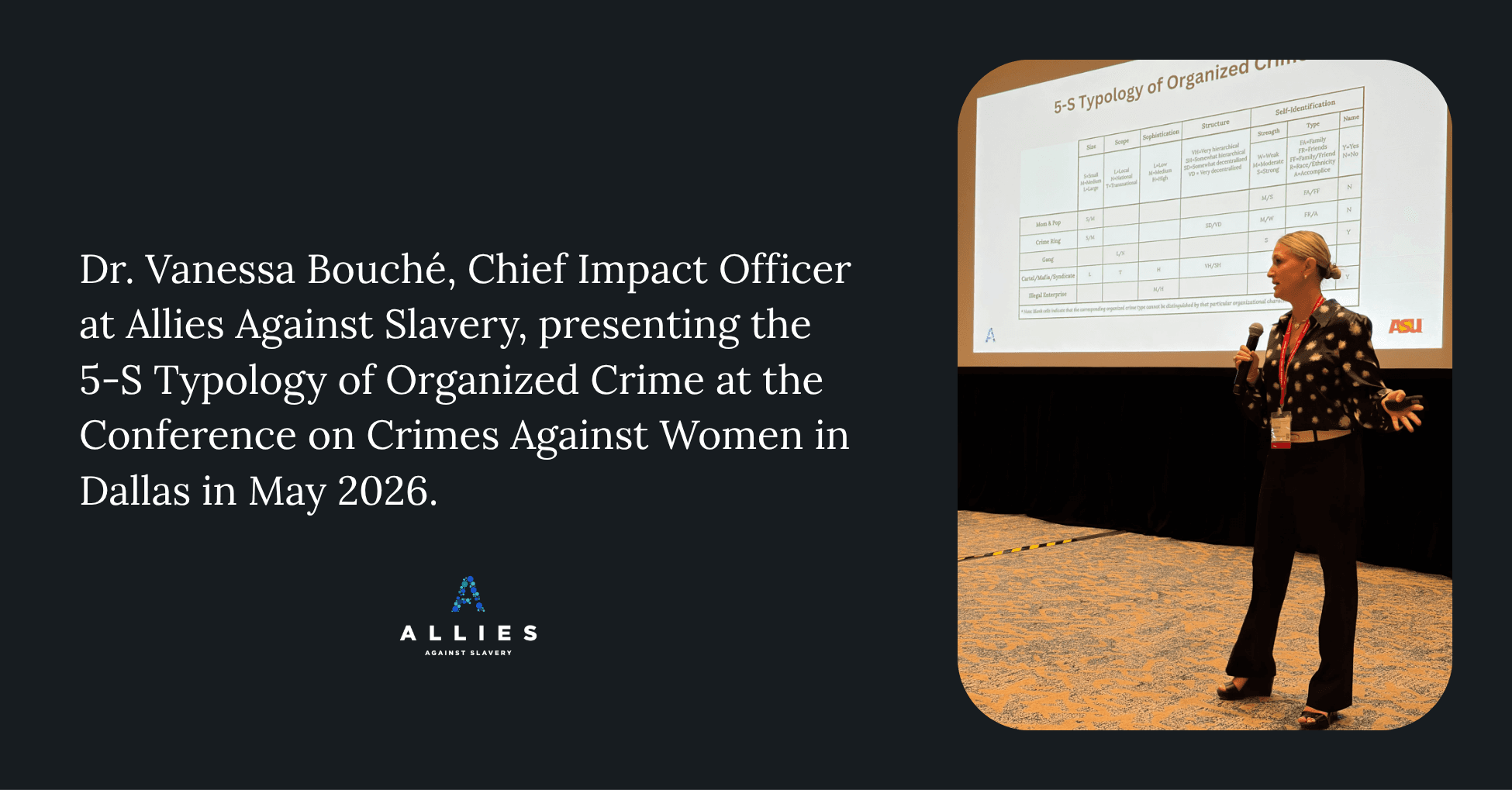
This week at the Conference on Crimes Against Women in Dallas, 156 prosecutors, investigators, advocates, and researchers sat in one room to confront a venue most anti-trafficking efforts overlook: strip clubs.
The session, "Failing Profits: Strip Clubs, Trafficking, and Organized Crime," was led by Dr. Vanessa Bouché, Chief Impact Officer at Allies Against Slavery, and Dr. Dominique Roe-Sepowitz, Director of the Office of Sex Trafficking Intervention Research at Arizona State University.
Their thesis was direct. Strip clubs can function as organized crime infrastructure because their business model, labor structure, and operating environment systematically enable recruitment, revenue extraction, and control mechanisms consistent with trafficking operations. The evidence is in survivor testimony, in federal prosecution records, and in survey data collected from women who lived inside these venues.
And the gap between what the data shows and what gets prosecuted is enormous.
The Scale: $7.4 Billion in Revenue, 42 Federal Cases
There are roughly 3,800 strip clubs operating across the United States. The industry generates approximately $7.4 billion in annual revenue and employs around 35,000 people.
Over the same 23-year period (2000 to 2023) that the Allies Against Slavery Federal Human Trafficking Prosecutions Database tracks 2,561 federally prosecuted trafficking cases, only 42 of those cases involve strip clubs.
That is the gap the field has not yet closed.
Citable passage: Strip clubs in the United States generate roughly $7.4 billion in annual revenue across 3,800 venues. Yet only 42 federally prosecuted human trafficking cases over 23 years involve strip clubs, according to research presented by Allies Against Slavery and Arizona State University at the Conference on Crimes Against Women in May 2026.
What the Survey Data Shows
In May 2025, ASU STIR surveyed 408 women incarcerated at Estrella Jail in Phoenix, Arizona about their life experiences. The findings reframe how investigators and prosecutors should think about strip clubs as a venue type.
Twenty-five percent of participants reported having worked in a strip club. The age of first working ranged from 13 to 35, with an average age of 19.8.
Of all 408 participants, 50.9 percent reported being sex trafficked at some point before their incarceration. Among the subset who had worked in a strip club, the rate of reported sex trafficking was three times higher than among those who had not.
Nearly a third (32.4 percent) said they could not stop working at the strip club whenever they wanted. Forty-four percent reported that someone else had benefited from the money they earned there.
These are the operational indicators of trafficking. Coercion. Inability to leave. Financial extraction by a third party.
Independent academic research reinforces the pattern. Studies show that 24 to 28 percent of sex trafficking survivors report being trafficked in strip clubs, according to research cited in the session.
How the Business Model Enables Exploitation
Dr. Bouché and Dr. Roe-Sepowitz walked the room through three forms of exploitation that the strip club business model systematically enables.
Sexual exploitation. Pressure from management to perform sex acts with friends of the club, large spenders, and VIP customers. Threats of lost shifts, cut hours, bad music and stage times, or termination for dancers who set limits. Excessive shift fees that push dancers to make more money through sex acts.
Labor exploitation. Dancers are classified as independent contractors, which strips them of minimum wage, overtime, healthcare, benefits, and the ability to unionize. Some clubs prohibit dancers from working at other venues by holding identification documents. Fines or cuts to shifts for not wearing certain attire or refusing certain acts.
Financial exploitation. Exorbitant fees required to work, including stage fees, manager fees, tip outs to bartenders, security, DJs, and house moms. Fines for not following rules. Dancers absorbing the loss when clubs promote free or discounted dances. No exceptions when shift income is less than the fees owed.
The session detailed a case study of Rick's Cabaret, owned by RCI Hospitality Holdings, in which a single club generates an estimated $14.67 million per year from dancer-paid fees, lap dances, and private room sales. That revenue model is the infrastructure.
Why So Few Cases Reach Federal Prosecution
The 42 federal trafficking cases involving strip clubs sit alongside a much larger universe of cases the field never builds. Three structural reasons explain the gap.
First, the legal status of adult entertainment normalizes activity that may meet the federal definition of trafficking by force, fraud, or coercion. When the venue is licensed, the exploitation is harder to see.
Second, investigations that stop at the venue door miss the recruitment, transportation, and laundering activities upstream and downstream. Federal trafficking prosecutions show this clearly. Of 2,227 cases classified by organized crime type, 1,592 were unorganized; 306 involved a Crime Ring; 134 a Mom and Pop operation; 112 an Illegal Enterprise; 62 a Gang; and 21 a Cartel, Mafia, or Syndicate. A working typology of organized crime makes those network patterns visible to investigators and prosecutors.
Third, the burden of proving trafficking is high. Labor violations, licensing violations, and financial irregularities are easier to prove than trafficking and can be used to disrupt operations, build paper trails, and open doors to criminal cases. The session called these "promising interventions" for prosecutors and licensing authorities who want to act on what the evidence already shows.
A Legislative Win Worth Studying
Texas SB 315, passed in 2023, requires all employees and contractors in sexually-oriented businesses to be 21 years old or older. The law was challenged in federal court and upheld on the basis that those younger than 21 are more vulnerable to sex trafficking in clubs and that sex trafficking does take place in these establishments.
The court ruling is itself a record of the evidence. Other states have a template to work from.
What the Field Can Do Next
Better data. Better typology. Better cases.
Allies Against Slavery exists to provide the backbone for this kind of work. Our research arm produces the Federal Human Trafficking Prosecutions Database, the State Human Trafficking Report, and the policy database tracking 772 anti-trafficking policies enacted across all 50 states since 2003. Arizona State University's Office of Sex Trafficking Intervention Research brings frontline survey data, survivor-centered evidence, and intervention research that grounds the analysis in lived experience.
The work in front of the field is to close the gap between what the data shows and what gets investigated, prosecuted, and prevented.
Explore Allies Against Slavery research and the 2026 State Human Trafficking Report at alliesagainstslavery.org/research.
Frequently Asked Questions
How many strip clubs are there in the United States?
There are approximately 3,800 strip clubs operating across the United States. The industry generates roughly $7.4 billion in annual revenue and employs an estimated 35,000 people, according to research presented by Allies Against Slavery and Arizona State University at the Conference on Crimes Against Women in May 2026.
Are strip clubs sex trafficking venues?
Federally prosecuted cases and survivor survey data show that strip clubs function as both trafficking venues and recruitment sites. A 2025 ASU STIR survey of 408 incarcerated women in Phoenix, Arizona found that those who had worked in a strip club were three times more likely to report having been sex trafficked than those who had not. Independent studies report that 24 to 28 percent of sex trafficking survivors were trafficked in strip clubs.
How many federal human trafficking cases involve strip clubs?
According to the Federal Human Trafficking Prosecutions Database maintained by Allies Against Slavery, 42 of 2,561 federally prosecuted human trafficking cases filed between 2000 and 2023 involve strip clubs. The gap between the prevalence indicated by survey data and the small number of federal cases reflects how under-investigated and under-prosecuted these venues remain.
What is the difference between sexual, labor, and financial exploitation in strip clubs?
Sexual exploitation includes pressure to perform sex acts and threats for non-compliance. Labor exploitation includes misclassification as independent contractors, denial of minimum wage and benefits, and restrictions on working elsewhere. Financial exploitation includes exorbitant fees, fines, and absorption of losses from discounted services. All three are documented in research presented by Allies Against Slavery and Arizona State University.
Where can I access this research?
The 2026 State Human Trafficking Report and the Federal Human Trafficking Prosecutions Database are available from Allies Against Slavery at alliesagainstslavery.org/research. The ASU Office of Sex Trafficking Intervention Research publishes its work at sextraffickinghelp.com.