A Blueprint for the Anti-Trafficking Data Ecosystem We Need
Mar 23, 2026
For more than two decades, the anti-trafficking field has collected data in silos. Different agencies use different definitions. Different states use different tools. And the result is a fragmented picture of a problem that demands a unified response.
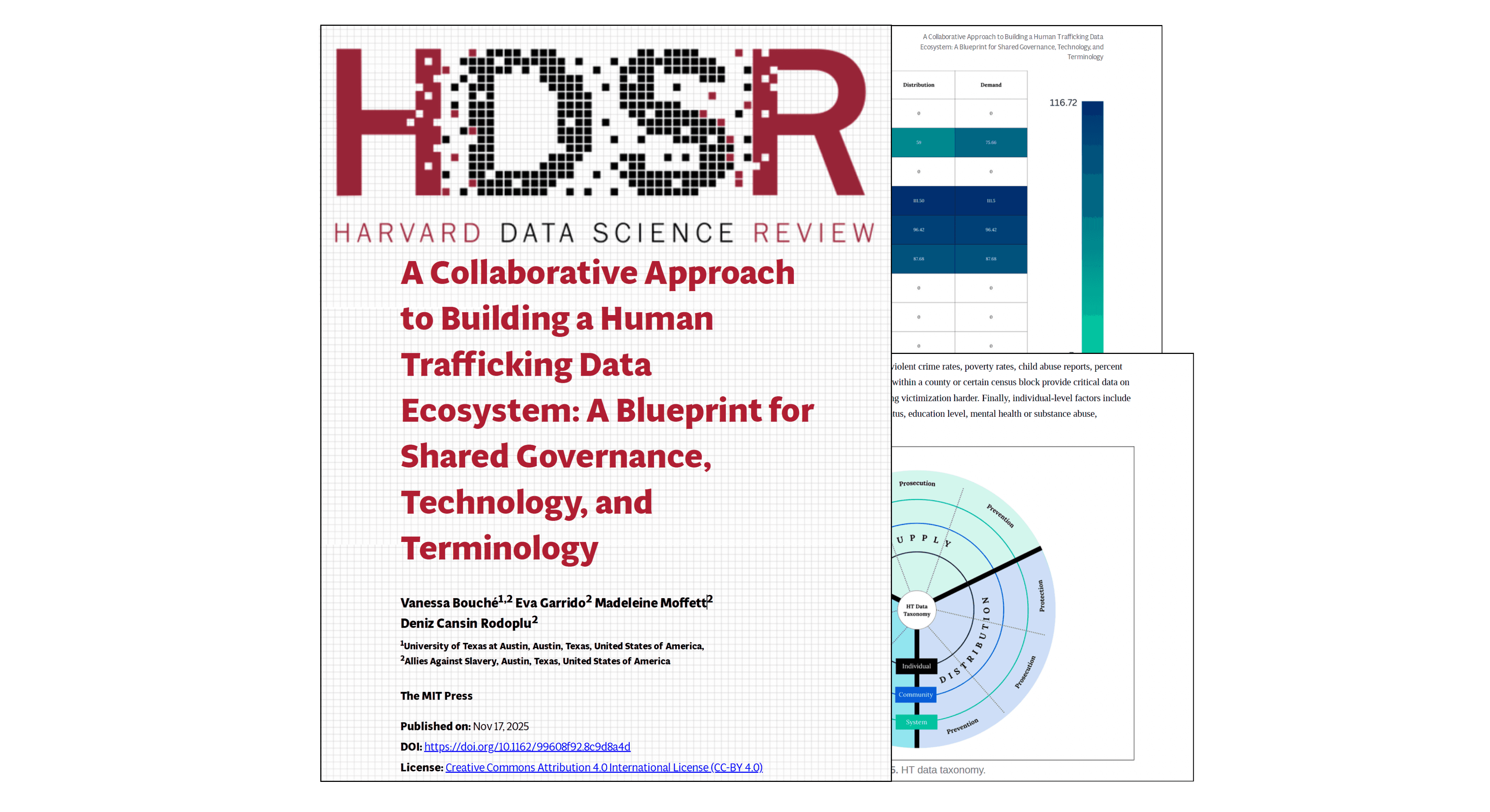
A new peer-reviewed article published in the Harvard Data Science Review offers a way forward. Authored by Dr. Vanessa Bouché alongside Eva Garrido, Madeleine Moffett, and Deniz Cansin Rodoplu of Allies Against Slavery, the article presents a comprehensive framework for building a national human trafficking data ecosystem.
The framework has three interconnected parts: a data trust for shared governance, a data hub for modern technology infrastructure, and a data taxonomy for common terminology. Together, they form a blueprint for transforming how the field collects, shares, and uses data to protect survivors and prevent trafficking.
Why the Current System Falls Short
The anti-trafficking field faces six persistent data challenges that limit our collective ability to measure the problem, track progress, and deliver evidence-based solutions.
First, there is no shared definition of key terms like "prevention" and "protection." Different agencies interpret these concepts differently, which means data collected in one jurisdiction often cannot be compared to data collected in another.
Second, data collection practices are not standardized. Screening tools vary. Reporting protocols vary. Even law enforcement agencies within the same state may record trafficking cases differently.
Third, the scope of existing data is too narrow. Sex trafficking receives the majority of research attention. Labor trafficking is frequently overlooked. And critical actors like traffickers and buyers remain understudied.
Fourth, data is fragmented across organizations and systems. Federal, state, and local agencies operate independently. Law enforcement, service providers, and researchers each maintain separate records with little integration.
Fifth, there is no centralized data governance. No legal framework defines who can access, use, or share trafficking data, or under what conditions. This creates hesitation among agencies concerned about privacy, liability, and data misuse.
Sixth, much of the field's data infrastructure is outdated. Legacy systems lack interoperability, real-time analytics, and the scalability needed for modern data collaboration.
These challenges are significant. But they are not insurmountable. Other fields facing similar complexity have built effective data ecosystems. The article draws lessons from public health, criminal justice, refugee data systems, and gender-based violence management to show what is possible.
Three Building Blocks of a Data Ecosystem
The article proposes three interconnected components to overcome these challenges.
A Data Trust for Shared Governance
A data trust is a legal structure that provides independent stewardship of data. It gives organizations the confidence to share data in a safe, fair, and equitable way.
For the anti-trafficking field, a data trust would establish the rules: who can access what data, under what conditions, and for what purpose. It would be governed by an advisory council representing data contributors, lived experience experts, government agencies, academic institutions, and community members.
Allies Against Slavery's experience building the Lighthouse platform offers practical lessons here. Trust can be cultivated by embedding survivor-informed governance, HIPAA-level privacy standards, and clear data use agreements. And it often starts small, with relationship-based partnerships that prove the value of shared data before expanding.
A Data Hub for Modern Infrastructure
While the data trust sets the rules, a data hub provides the technology to put those rules into action.
Allies Against Slavery's Lighthouse platform serves as a working example. Since 2020, Lighthouse has operated as a data hub that collects, standardizes, and connects diverse trafficking data sets. The platform currently houses 11 different data sets received in 24 unique formats, covering everything from youth screening data to federal prosecutions to online commercial sex advertisements.
Lighthouse is a cloud-based platform hosted on Amazon Web Services. It supports advanced security, API integration, and the potential for AI-powered data preparation and analysis. Unlike traditional repositories that rely on static reports, Lighthouse offers interactive visualizations and continuously updated data.
The article also explores future possibilities, including federated machine learning. This approach would allow partner agencies to contribute to shared insights without ever transferring sensitive data to a central location. Each agency trains models on its own data locally. Only the model parameters are shared. This protects privacy while enabling collective intelligence.
A Data Taxonomy for Common Language
The third component addresses the field's lack of definitional clarity. Allies Against Slavery developed a human trafficking data taxonomy that organizes data along three intersecting dimensions.
The first dimension is the condition model: supply (victims and vulnerable populations), demand (market drivers), and distribution (the people, networks, and mechanisms that connect supply to demand).
The second dimension is the intervention model, drawn from the TVPA's 3P framework: prevention, protection, and prosecution.
The third dimension is the social-ecological model: individual, community, and system-level factors.
By intersecting these three frameworks, the taxonomy creates 27 distinct categories. Each category represents a specific area where data can inform anti-trafficking efforts. For example, "prevention of supply at the individual level" might include screening data and community risk factors. "Prosecution of demand at the system level" might include federal case data and state policy analysis.
What the Data Reveals About Our Gaps
The article applies a quantitative scoring system to evaluate the quality and coverage of data within Allies Against Slavery's Lighthouse Data Hub. Each data set is scored on seven criteria across two categories: reliability and validity (freshness, definitional consistency, completeness, and taxonomic applicability) and coverage (temporal, geographic, and demographic).
The resulting heat map analysis reveals both strengths and critical gaps.
Prosecution data scores highest, with an average normalized quality score of 7.36 out of 10. This reflects the field's historic emphasis on criminal justice responses.
Prevention data scores significantly lower at 3.7. Protection data is the weakest at 2.68. These gaps represent real blind spots in how we resource and respond to trafficking.
Across the condition model, supply is the most represented overall, but the quality of supply-side data is lower than distribution or demand data. And as we move from individual-level to system-level data, quality declines. Individual-level data sets average 6.57, while system-level data sets average only 4.08.
These patterns matter. Without strong prevention and protection data, our responses remain reactive. Without system-level data, we lack the structural and policy-level insights needed to inform upstream interventions.
The heat map also reveals an encouraging finding: even a single data set within an empty category significantly improves the overall quality score. This means the field does not need to wait for perfect data. Small, targeted contributions can yield outsized value.
What Comes Next
This framework is not theoretical. It is being built. Allies Against Slavery's Lighthouse platform already serves as a functioning data hub, and the taxonomy provides a strategic blueprint for where to invest next.
Several things are needed for this vision to advance. Trust-based partnerships across sectors must deepen. Legislative mandates for standardized data collection at the state and federal levels would accelerate progress. And sustainable collective impact funding is essential to support the collaborative infrastructure this work requires.
The article also points to the global potential of this approach. Interoperable data hubs, shared taxonomies, and a governance framework for ethical data stewardship could form the foundation for a transnational human trafficking data ecosystem, strengthening the ability of countries to align policies and coordinate prevention strategies across borders.
Ultimately, the beneficiaries of a more robust data ecosystem must be survivors. Their lived experiences should shape the priorities of data collection, governance, and use. By centering survivor leadership and embracing a shared, rigorous approach to data, the anti-trafficking field can move closer to lasting, systemic change.
Frequently Asked Questions
What is a human trafficking data ecosystem?
A human trafficking data ecosystem is an integrated framework of governance (data trust), technology (data hub), and shared terminology (data taxonomy) that enables organizations to collect, share, and use trafficking data ethically and effectively. Allies Against Slavery's peer-reviewed article in the Harvard Data Science Review proposes the first comprehensive model for building this ecosystem.
What is the Lighthouse platform?
Lighthouse is a data hub powered by Allies Against Slavery that has operated since 2020. It currently houses 11 different data sets received in 24 unique formats, spanning youth screening data, federal prosecutions, state policies, and commercial sex advertisement data across multiple states.
What did the heat map analysis find?
The analysis found that prosecution data is the strongest area (average score of 7.36 out of 10), while prevention (3.7) and protection (2.68) data are significantly weaker. System-level data across all categories averaged only 4.08, highlighting the need for structural and policy-level data investments.
How does a data trust protect survivor privacy?
A data trust establishes legal and governance rules for who can access data, for what purpose, and under what conditions. It embeds survivor-informed governance, privacy standards like HIPAA compliance, and clear data use agreements that specify ownership, access rights, and permissible use.
Where can I read the full article?
The full peer-reviewed article, "A Collaborative Approach to Building a Human Trafficking Data Ecosystem," is published in the Harvard Data Science Review, Issue 8.1, Winter 2026, and is available at hdsr.mitpress.mit.edu.
Explore the Data
See how Allies Against Slavery is building the backbone of a national anti-trafficking data ecosystem