What You Helped Build in 2025: Allies Against Slavery's Impact Report
Apr 7, 2026
About a decade ago, we found ourselves unable to answer what seemed like a simple question: Are we getting any closer to ending human trafficking?
The answer required better data. So we focused our mission on building it.
In 2025, that mission was put to the test. Like many nonprofits, we navigated an uncertain environment. State funding retracted. The landscape shifted. Yet partners stepped up. And the data confirmed what we had believed for years: when we bring people and data together, we can change systems and lives.
Here is what we accomplished together.
42,330 Screenings for Human Trafficking in 2025
Allies Against Slavery's Lighthouse Screening platform is the backbone of our identification work. In 2025, partners across 203 organizations in Texas and Louisiana used the platform to conduct 42,330 screenings for trafficking. Of those, 3,454 were categorized as "Clear Concern," meaning they were identified as presumed victims of human trafficking.
Without systematic screening, many of these individuals would remain invisible to the systems meant to help them. Identification is the first step in accessing services, protection, and recovery.
The platform supports the validated Commercial Sexual Exploitation Identification Tool (CSE-IT), along with emerging tools developed with state partners. In Louisiana, Lighthouse supported the rollout of a new labor trafficking identification tool and a new sex trafficking identification tool, expanding what agencies can screen for and building the evidence base for these instruments across the state.
Our team also conducted 65 trainings in 2025, reaching 703 professionals across 134 agencies and 55 counties in Texas.
Lighthouse Data: 13 Datasets, 29 Million Ads, One Platform
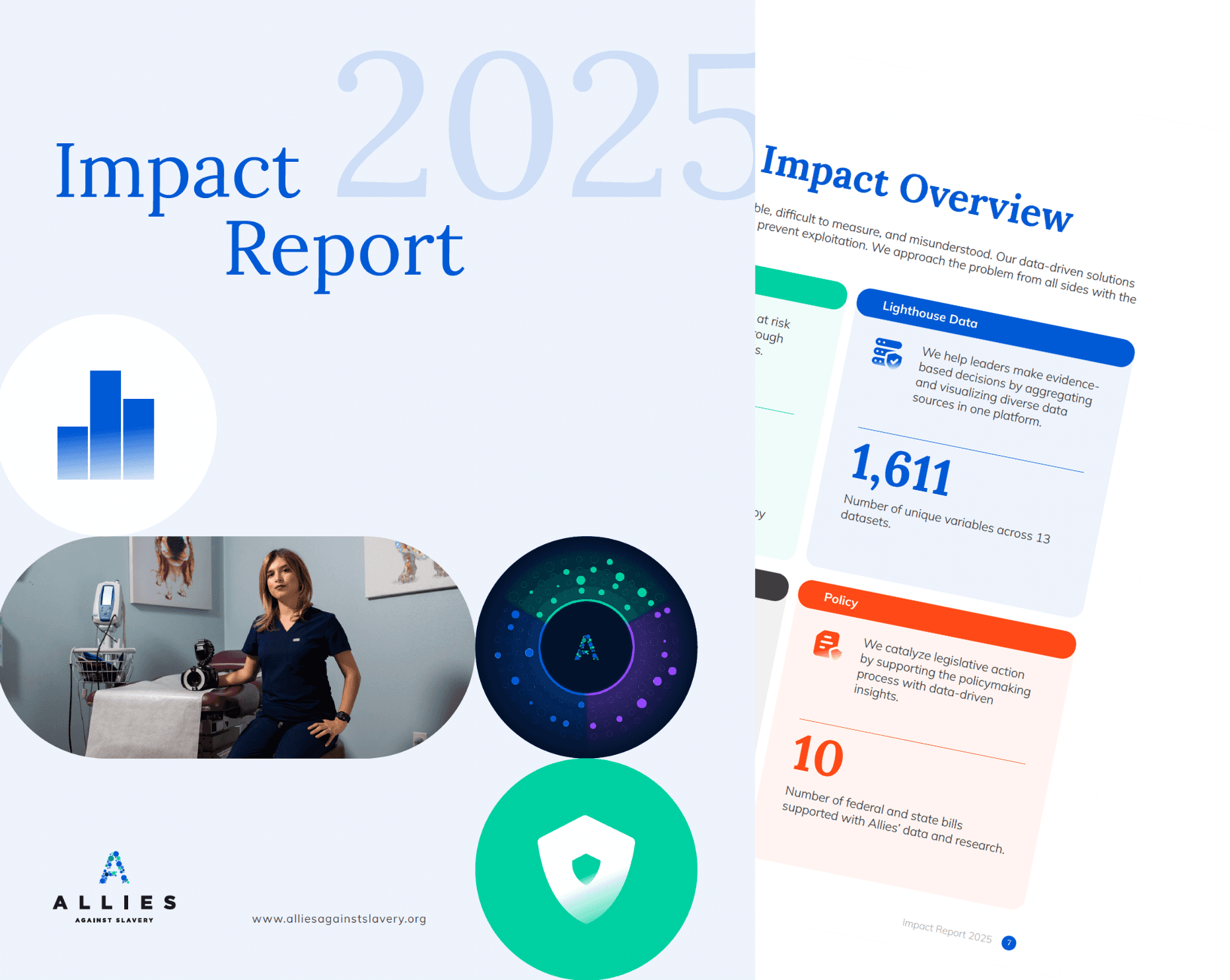
Allies Against Slavery's Lighthouse Data platform brings together diverse sources of trafficking-related data to help leaders make evidence-based decisions. In 2025, the platform grew to 13 major datasets with more than 1,600 variables, serving 235 users across three states.
One of the biggest additions was nationwide data on commercial sex advertisements, collected with the University of Alabama's Institute for Data Analytics. In 2025, the system tracked more than 29 million ads across the United States, a proxy for the demand that drives sexual exploitation. To our knowledge, Lighthouse is the only platform visualizing these trends at national scale.
We also launched a public data explorer on our website, making portions of Lighthouse Data accessible to anyone for the first time. And we piloted a Data-as-a-Service model, enabling partners to conduct custom analyses using our data ecosystem, including a predictive trafficking risk model developed ahead of a major sporting event in North Texas.
Research and Policy: From Data to Action
Our research program translates Lighthouse data into actionable knowledge. In 2025, Allies Against Slavery published five major reports, including the inaugural 2025 State Human Trafficking Report, which tracks two decades of state policies and federal prosecutions across all 50 states. The report reached over 1,700 online views and was referenced in the U.S. State Department's Trafficking in Persons Report.
We also published three peer-reviewed academic articles and delivered 19 speaking engagements in 8 states, three national webinars, and numerous podcast and media appearances. In total, our research reached thousands of practitioners, policymakers, and advocates across the country.
On the policy front, we helped pass two landmark measures in Texas: a statewide data repository bill mandating the collection of human trafficking data, and HB 451, which mandates universal screening for commercially sexually exploited youth. We also supported the Take It Down Act at the federal level and the Ink of Hope Act in Tennessee.
Financial Stewardship: 84 Cents of Every Dollar to Programs
In 2025, Allies Against Slavery brought in just under $1.5 million in total revenue, an increase over the prior year. That support came from a diversified mix: foundations at 32%, state partners at 31%, individual donors (including our Lightkeepers) at 23%, and corporate partners at 14%.
Total expenses came in at just over $1.25 million, with 84 cents of every dollar going directly to programs. We ended the year with an operating surplus of nearly $223,000, our strongest financial position since 2023.
Why Our Partners Invest: Voices from the Field
None of this work happens without the people who fund it. At our 2025 Impact Webinar, we sat down with four of our funding partners to hear why they invest and what they see in this work. Their perspectives say more than we ever could.
Mark McClain, CEO of SailPoint and a deeply committed funding partner, was drawn to the upstream approach. He saw an organization that connects head and heart, bringing real intelligence and a data-driven model to one of the most hidden problems in the world. When asked about what drew him in, Mark put it simply: "How do we find the problems before they become crises? You guys are putting a light on it and exposing it."
And when it came to making the case for support, Mark reframed the entire conversation. "Sometimes you look at philanthropic funding differently than for-profit investment, but I don't, actually," he said. "You have to have a problem worth solving, a product well-suited to address the problem, and a team that can execute. It's a still largely unsolved problem, great product to go after it, great team to execute it."
Sally Frank, who leads anti-human exploitation work at Block, brought a different perspective. Before joining Block, Sally spent years working directly with trafficking survivors at a child advocacy center in Texas. When she moved into the corporate world, she discovered something: businesses need data before they act. "Show us the data, show us the why," her colleagues told her. That led her to Allies Against Slavery. "There are so few places like Allies that are so focused on what does the data say," Sally shared. She also offered a reflection that stuck with us: "You're a name in the moment that it matters, and you're a name where the world needs to see it to make change."
Janet Jensen, one of our longest-standing foundation partners through The Jensen Project, pointed to something that matters deeply to us: trust. "As a funder, it's really pleasant to hear the good, the bad, and the ugly," Janet said. "You know where they are, you know if you can help." That kind of transparency is not always easy, but it is at the core of how we build partnerships.
Rebecca Powers, a Lightkeeper (monthly donor) for over a decade, has watched Allies Against Slavery grow from its earliest days. "I'm all about impact, I'm about sustainability, I'm about data-driving decisions, and Allies does all of that," she said. Rebecca also spoke to something we do not take for granted: the confidence to recommend us to others. "It gives me a way to feel confident in sharing why I give to Allies with people who ask me where I make my commitments."
These voices represent the full spectrum of how people invest in this mission, from transformational corporate partnerships to monthly gifts that sustain us year-round. Every one of them is building the backbone of a field that fights trafficking with evidence, not just effort.
Where We're Headed: A Collaborative Data Ecosystem
Our North Star for 2026: strengthen our foundation, expand our data offerings, and equip more partners to find and protect survivors.
The biggest initiative on the horizon is building one of the first collaborative data institutions for the anti-trafficking field. Right now, critical data still sits in silos across organizations. This initiative creates the shared governance, standards, and infrastructure needed so that organizations can share data without compromising privacy or autonomy.
This is the long game. And it is the kind of infrastructure that changes how trafficking is fought across the country.
Read the Full 2025 Impact Report
This post is a snapshot. The full report goes deeper into each program area, with partner stories, state-level data, and detailed financials.
Every data point we collect represents a real person. We never want to lose sight of that.
Download the full 2025 Impact Report
Frequently Asked Questions
How many screenings for trafficking were conducted in 2025?
In 2025, 42,330 screenings for trafficking were conducted across Texas and Louisiana using Allies Against Slavery's Lighthouse Screening platform. Of those, 3,454 were identified as "Clear Concern" for trafficking, meaning they were presumed victims in need of services and protection.
What is the Lighthouse Screening platform?
Lighthouse Screening is Allies Against Slavery's cloud-based platform that digitizes and standardizes screening for human trafficking. The platform supports the validated Commercial Sexual Exploitation Identification Tool (CSE-IT) and other emerging screening instruments, and was recognized by the U.S. Department of Health and Human Services as a national award-winning innovation.
What is Lighthouse Data?
Lighthouse Data is Allies Against Slavery's comprehensive data and insights platform that aggregates multiple sources of trafficking-related data. In 2025, the platform included 13 major datasets with more than 1,600 variables, serving 235 users across three states. It enables policymakers, researchers, and practitioners to analyze trafficking trends and make evidence-based decisions.
How many commercial sex advertisements did Lighthouse Data track in 2025?
Allies Against Slavery's Lighthouse Data platform tracked more than 29 million commercial sex advertisements across the United States in 2025, in partnership with the University of Alabama's Institute for Data Analytics. Lighthouse is currently the only platform visualizing commercial sex advertising trends at this national scale.
Where can I access the 2025 Impact Report?
The full 2025 Impact Report is available for download on Allies Against Slavery's website at alliesagainstslavery.org/impact. Portions of Lighthouse Data are also publicly accessible through the Allies Insights data explorer on the website.